Seafood in Mui Ne: the Market Sells by the Basin, Not by the Kilo
Updated October 1, 2026 · 8 min read
Of the 137 offers in our inventory for Mui Ne, exactly one is a food tour. That is not an oversight in the market – it is the shape of the place. Eating here is something that happens in the evening, on a plastic stool, without a booking, and almost everything worth knowing about it is about how the money changes hands rather than where the good restaurants are.
This is the part that no itinerary covers, and it is the part that decides whether you pay 100,000 VND or 800,000 for dinner.
The fishing village market sells by the basin, not by the kilo
The market sits at 321 Huỳnh Thúc Kháng, in the fishing village at the far end of the strip – the same village that 46 of our tour offers stop at, from €5.66, for a quarter to half an hour with a camera. Going back on your own, without the minibus, is a different errand entirely.
The thing to understand before you arrive: much of the seafood here is priced by the basin, not weighed. You look at a plastic tub, the seller names a price for what is in it, and that is the transaction. Prices start around 100,000 VND and go up from there. A basin holding three to five lobsters is reported in the 400,000 to 1,000,000 VND range. Garlic snails, sold by weight, run roughly 220,000 to 270,000 VND per kilo; lobster by the kilo is around 900,000.
It sounds like the kind of arrangement that favours the seller, and sometimes it does. But look at what the warnings about this market are actually about: frozen stock passed off as fresh, and rigged scales – cân điêu, a word common enough in Vietnamese to need no explanation. A price set on a basin you can see removes the scale from the argument entirely. You are negotiating about something in front of you rather than about a number on a display. Whether you do well out of it depends on what you put in the tub, which is a more honest problem to have.
Two practical points. Come between 5 and 7 am if freshness is the priority – that is when the boats are in and the market is a market rather than a leftover. And you do not have to carry your purchase anywhere: sellers will cook what you have just bought, on the spot. The price for that is negotiated like everything else here, so settle it before the pan goes on, not after.
If none of that sounds like a holiday, it is a perfectly reasonable conclusion, and the restaurants on the resort strip exist for exactly that reason. They are more expensive and they will weigh things. Both answers are fine; what is not fine is arriving at the market expecting the second one.
Bánh xèo here is not the bánh xèo you have eaten elsewhere
This is the single most local thing on this page, and most visitors never find out it is a difference.
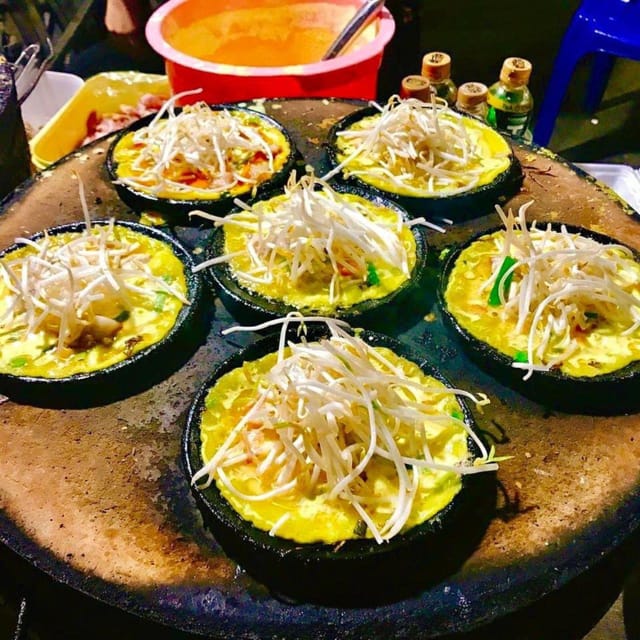
Everywhere else in Vietnam, bánh xèo is a large crisp crepe, folded over and cut up, wrapped in herbs and lettuce. In Phan Thiet and Mui Ne it is made in a set of small cast-iron moulds, each about the width of a hand, and it comes out the size of a palm – yellow from the turmeric in the rice batter, topped with bean sprouts and whatever seafood went in.
Because it is small, it is eaten differently. It is not cut and not rolled. You fold one in half, dip the whole thing in fish sauce, and it is gone in a couple of bites. A serving is usually five of them, and each one costs around 10,000 to 12,000 VND.
Do the arithmetic on that and you have the cheapest meal described anywhere on this site. It is also the one dish you cannot order correctly elsewhere afterwards, because what arrives will be the other thing.
The fish sauce is what this coast is actually known for
Fish sauce is the reason Phan Thiet has a name beyond the dunes. Phan Thiet has been a registered geographical indication for nước mắm since 2007, protected indefinitely for sauce produced to standard within Binh Thuan province – the same legal instrument that protects a regional cheese or wine in Europe, applied to a condiment.
What sits behind the label is worth knowing because it explains the price range in any shop here. The sauce is made mainly from anchovy, cá cơm, layered with salt and left to break down for somewhere between 8 and 18 months. The grade is measured in degrees of nitrogen: a solid first pressing lands around 28 to 30°N, the premium grades at 35 to 37, and a handful of producers have reached 42 to 43. A bottle at the top of that scale and a bottle at the bottom look identical on a shelf.
If you want the long version, the Làng Chài Xưa fish sauce museum at 360 Nguyễn Thông, Phú Hài, in Phan Thiet, publishes daily opening from 9 am to 6 pm and an adult admission of 100,000 VND, across fourteen themed rooms. Those figures come from the museum’s own published information and from travel listings, not from a visit by us – worth a check on the day, as with any opening time in Vietnam.
It also turns up on a tour: the Ke Ga lighthouse and fish sauce museum trip pairs the museum with the lighthouse and a dragon fruit farm, at €49.32, bookable with or without a guide. It has no reviews yet, which is a reason to read the description closely rather than a reason to avoid it. The rest of that stretch of coast is on the Ke Ga and Cham towers page, where eight offers start at €44.10.
The one food tour, and what you are paying for
Mui Ne Food Tour by Jeep runs from 4:30 pm to 8:30 pm, four hours, €51.26 per person, 4.8 stars from 4 reviews. The operator is Johnny Tours Mui Ne. You are collected from your hotel lobby, driven to the fishing village in an open jeep for the sunset, and then eat your way through the village: grilled rice paper with mắm ruốc, nem nướng, fried spring rolls, the seafood bánh xèo described above, and peanut milk at the end at a sea-view bar.
Food, drinks, the private jeep and an English-speaking guide are included. Tips and anything personal are not.
Now the honest part, because the sum does not work out on its own. The food on that list, bought the way the people around you are buying it, costs a small fraction of €51.26. What the price buys is a private jeep, a guide, the sunset at the village, and not having to negotiate anything in a language you do not speak. For some people on a short stay that is worth it outright. For anyone staying a week it is worth doing once and then going back alone.
And four reviews is thin evidence. A 4.8 built on four ratings tells you much less than the 4.8 built on 1,164 for the big dunes tour, and should be read as “nobody has complained yet” rather than as a track record. The listing is marked wheelchair accessible; given that the evening involves an open jeep, street stalls and a village lane, that is one to confirm with the operator before booking rather than take on trust.
Fitting it into the rest of the trip
The fishing village is already on almost every dunes itinerary, which is why it is tempting to treat the food as covered. It is not: on a sunrise tour the village stop is the morning market, on an afternoon tour it is a view of moored boats, and in both cases it is fifteen to thirty minutes with a camera. What that stop is really like is set out in the guide to the Fairy Stream, the fishing village and the red dunes.
The simplest plan that works: take a sunrise jeep tour on one day, and on another go back to the market yourself in the early morning, buy a basin, and have it cooked there. The whole of the second day costs less than the tip on the first.
With children, the small bánh xèo travel better than anything else on this page – one at a time, no cutlery, no heat beyond warm. The rest of what does and does not work with them is in Mui Ne with children, and if you are only here for two days, the two-day plan says where the evening fits.
The full range of bookable things to do, 108 offers from €5.66, is on the things to do in Mui Ne page.